



Spring 2025 Lottery – Grand Prize 1 – $1,000,000
From bling to cha-ching!
Leo Lessard talks about his Spring 2025 Heart & Stroke Lottery win: Grand Prize 1, $1,000,000.
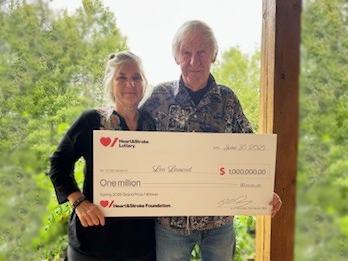
Spring 2025 Lottery – Grand Prize 1 – $1,000,000 Leo Lessard, Mattawa
When Leo bought his first Heart & Stroke Lottery ticket 25 years ago, it was simply to support a good cause. Since then, life has thrown him some serious challenges – four heart attacks, and most recently, an angioplasty. Just two days after coming home from the hospital, he was asleep on the couch when the phone rang.
The numbers matched.
“At first, I didn’t think it was legitimate – there are so many scams. I told the woman to call back in 10 minutes, while I went to find my ticket in the truck. When I returned, my wife Patti was on the phone, giggling.” Patti handed him the receiver, and Leo compared his ticket with the winning numbers. They matched.
Life suddenly became a lot more exciting.
With four adult children and six grandchildren, deciding what to do with their winnings was easy: “We’ll help our children and set aside education funds for our grandchildren. Patti and I are planning to visit our two sons in British Columbia, take a family trip to Aruba in February, and explore the East Coast after that. This win makes life a lot more comfortable – and exciting!”
Leo is proof: research saves lives.
Leo credits medical advances – many supported by Heart & Stroke – with giving him the chance to enjoy this moment. “Even if you don’t have a heart problem, it could happen to someone you love. If you can afford a ticket, buy one.”
Years ago, Leo won a Swarovski® crystal prize in the Heart & Stroke Lottery.
“We were happy with that! Never in a million years did we think we’d win a million…it’s far beyond anything we ever could have imagined.”
Lottery Past Winners

Knowing that Heart & Stroke is working on preventative research – where lives can be saved with earlier diagnosis – makes me hopeful for others.
— Danny Verlinden, London

If you don’t buy a ticket, you don’t win…and that also means less funding for research that could help your loved ones.
— Kim Morgan, White River